
Travel Tips
Bacares guide. Discover Bacares
Published December 28, 2025 | Category: Travel Tips
TL;DR: Bacares is one of the highest villages in Almeria, set deep in the Sierra de los Filabres. Known for cold winters, mountain landscapes, livestock traditions and a slow, resilient village rhythm far removed from coastal Andalusia. All the practical information.
Explore Bacares in the Sierra de los Filabres of Almeria
Table of Contents
- Introduction
- History & Heritage
- Nature & Walking Trails
- Culture & Local Life
- Gastronomy
- Festivals & Events
- Market
- Camper parking
- Getting There & Accommodation
- Itineraries & Day Trips
- Practical Information
Introduction: A High-Mountain Village in Inland Almeria
Hidden high in the northern reaches of the Sierra de los Filabres, Bacares is one of the highest and most isolated villages in the province of Almeria. At an altitude of around 1,200 metres, the village experiences a climate and rhythm that feel closer to inland Granada than to the Mediterranean coast.
This is a place shaped by altitude, winter cold and endurance. Bacares does not rely on tourism or seasonal visitors; it is a working mountain village where daily life still follows agricultural cycles, livestock care and weather conditions. Visitors arrive knowing they are entering a very different version of Andalusia.
History & Heritage
Bacares has deep roots in the Moorish period, when mountain villages across the Filabres range were established to control grazing land, water sources and strategic passes. Its location offered natural defence but demanded resilience from its inhabitants.
After the Christian reconquest and later population shifts, Bacares remained small and self-reliant. Unlike wealthier valley towns, it never expanded dramatically, preserving its compact layout and traditional mountain character. Whitewashed houses cluster tightly together, designed to protect against cold winds and heavy winter conditions.
The parish church and central square form the heart of village life, serving not only religious functions but also as gathering points during festivals and seasonal events.
A central element of Bacares’ identity is the devotion to the Santo Cristo del Bosque. The image is closely linked to local tradition and religious life, and has made Bacares a place of pilgrimage within inland Almeria. For generations, people from surrounding villages have travelled here seeking protection, healing or fulfilment of promises.
This devotion shapes both religious celebrations and everyday village identity. Even for non-religious visitors, the Santo Cristo del Bosque is part of the cultural fabric of Bacares — a reminder of how faith, landscape and isolation have historically intertwined in high mountain communities.
Bacares was also deeply affected by the conflicts of the 16th century, particularly during the Morisco uprisings. Like many mountain villages, it experienced population loss and periods of near abandonment, reinforcing its isolated character. This history of hardship and survival still shapes local identity today.
Nature & Walking Trails
Bacares sits in one of the most rugged natural environments in Almeria. The surrounding Sierra de los Filabres offers high-altitude landscapes, pine forests, rocky ridges and wide mountain views that stretch across the interior of the province.
Bacares is also a natural starting point for some of the most recognisable landscapes in the Sierra de los Filabres. One of the best-known local hikes leads towards the Tetica de Bacares, the highest peak in the range, visible from much of the village and deeply embedded in local identity. Routes in this area are demanding, with steep gradients and rapid weather changes.
Forestry tracks and mountain paths around Bacares also connect toward the higher Filabres plateaus and the Calar Alto area, offering wide views across inland Almeria. These routes are best suited to experienced walkers, especially outside summer months, and conditions can change quickly due to wind, snow or low temperatures.
- Mountain tracks: Steep paths and forestry tracks lead into higher elevations of the Filabres.
- Open terrain: Much of the landscape is exposed, with limited shade outside forested areas.
- Seasonal contrast: Snow and frost are common in winter, while summers remain cooler than in the valleys.
Walking here is physically demanding and best suited to experienced hikers. Good footwear, weather awareness and sufficient water are essential. The reward is solitude and some of the most dramatic inland scenery in Almeria.
Good to know: Walking around Bacares is not forgiving. There is very little natural shade, even on longer routes, and temperatures can rise quickly on clear days. In spring and autumn the sun can be deceptively strong, while in winter snow and ice are common. Always carry enough water and warm clothing, and avoid starting long walks late in the day.
Culture & Local Life
Life in Bacares remains closely tied to the mountains. Livestock farming, particularly sheep and goats, continues to play an important role, alongside small-scale agriculture adapted to altitude and climate.
The village has a strong sense of continuity. Many families have lived here for generations, and social life revolves around shared work, seasonal rhythms and community events rather than external influences. Bacares feels inward-looking in the best sense — focused on its own survival and identity.
Gastronomy
Food in Bacares reflects its mountain setting: hearty, practical and designed to sustain people through cold winters. Olive oil, legumes, potatoes and meat form the backbone of local cooking, often prepared as stews or slow-cooked dishes.
Dishes such as migas, meat stews and simple soups are common, particularly in colder months. Food is strongly associated with home cooking and communal meals during fiestas rather than restaurant culture. Eating in Bacares is about nourishment and tradition, not presentation.
Two dishes are especially associated with Bacares and its high-mountain setting. One is olla de trigo, a slow-cooked wheat and legume stew traditionally prepared during colder months, designed to provide warmth and energy in winter conditions. The other is potaje de hinojos, a fennel-based stew that reflects the use of wild mountain herbs and seasonal produce.
These are not restaurant dishes in the modern sense but communal foods, often prepared for family gatherings, fiestas or religious events. In Bacares, cooking has always been about sustenance and tradition rather than presentation, shaped by altitude, climate and long winters.
Local products such as house-cured embutidos (sausages and cold cuts), gurullos with partridge, and other hearty mountain dishes are also part of the traditional cuisine here. These reflect the village’s livestock and high-altitude agricultural heritage.
These dishes were not developed for taste alone, but to sustain people through the long, cold winters of the Sierra de los Filabres. At over 1,200 metres altitude, Bacares has historically relied on food that could provide energy, warmth and nourishment when access to supplies was limited.
Festivals & Events
Festivals in Bacares reflect both religious tradition and seasonal change. Patron saint celebrations and summer fiestas bring together residents and families who return to the village during holiday periods.
Bacares also celebrates the Fiesta del Romero in February, when people from the wider region gather to enjoy traditional foods and music before the main summer festivities.
Winter conditions often limit large events, making warmer months the main focus for celebrations. Dates vary each year and are announced locally. For a complete overview of local public holidays across all municipalities in the province, see our
Almeria Local Holidays 2026 guide.
Market
Bacares does not host a regular weekly street market. Due to its small population and mountain location, residents rely on shops within the village and on markets and services in larger nearby towns.
For weekly markets and a wider range of goods, people typically travel to nearby towns in the Almanzora Valley or other lower-lying areas such as Serón, Tíjola, Olula del Río and Purchena, where access is easier year-round.
Although Bacares does not have a weekly street market, the village does have small local shops that act as an essential lifeline for residents. These tiendas sell basic groceries, bread and everyday necessities, allowing visitors to stock up without leaving the village.
For a wider choice of fresh produce, clothing and household goods, people typically travel to larger market towns such as Serón or Tíjola, where weekly markets serve the wider highland area.
Camper parking
Bacares is not a typical destination for camper or motorhome travel. The steep access roads, winter weather conditions and lack of services make it unsuitable for casual overnight stays.
There is no official camper area in the village, and parking options are limited by terrain and narrow streets. Camper travellers are advised to treat Bacares as a day-visit destination rather than an overnight base.
For full services such as water refill, electricity and waste disposal, motorhome travellers typically base themselves in lower-altitude towns in the Almanzora Valley, such as Tíjola, Olula del Río, Serón or Purchena, and visit Bacares by car when weather and road conditions allow.
Getting There & Accommodation
By car: Bacares is accessed via mountain roads from the Almanzora Valley. The drive is scenic but winding, and winter conditions can affect accessibility.
Public transport: Very limited; a car is essential.
Accommodation: Options within Bacares are limited. Rural accommodation and small guesthouses are more readily available in surrounding towns.
Itineraries & Day Trips
- Mountain day: Drive up from the valley → explore the village → short mountain walk → return before dusk.
- Filabres route: Combine Bacares with other highland villages for a full-day mountain itinerary.
- Seasonal contrast: Visit Bacares in winter for snow landscapes, or in summer to escape valley heat.
Practical Information
- Region: Sierra de los Filabres.
- Altitude: Approximately 1,200 metres above sea level.
- Climate: Cold winters with frost and snow; mild summers.
- Basics: Very limited services; plan supplies in advance.
- Municipal information: For local notices and administration, see the official page of the
Ayuntamiento de Bacares. - Emergency number (Spain): 112
Bacares is not a village you stumble upon by accident. It is a place for those who deliberately seek altitude, silence and a way of life shaped by mountains rather than the Mediterranean.
For more rural destinations across the province, explore our Towns & Villages category.
Travel Tips
Almond blossom routes in Almeria: villages, walks and when to go
Published January 8, 2026 | Category: Travel Tips
TL;DR: The Rutas del Almendro en Flor (Almond blossom routes) are guided winter walks through inland Almeria villages, usually held from late January to mid-February. The official 2026 programme is not yet fully published.
Rutas del Almendro en Flor in Almeria: what to expect in 2026
The Rutas del Almendro en Flor (Almond Blossom Routes) are one of the most atmospheric winter experiences in Almeria province. For a few weeks, inland hills and valleys turn white and pale pink, and a series of guided walks and village activities invite visitors to see a side of Almeria that feels far removed from the coast.
Think of it as a very Andalusian version of “hanami”: not formal, not over-produced, just a seasonal moment that locals enjoy, with simple routes, good food, and villages that feel calm even at the height of bloom.
Where are the almond blossom routes?
The routes focus mainly on the inland comarca around Filabres-Alhamilla, with occasional extensions toward Alto Nacimiento and the Valle del Almanzora. You’re looking at small villages and mountain scenery rather than big towns.
When is almond blossom season in Almeria?
Bloom varies year to year, but the usual window is late January to mid-February, with a peak often falling somewhere between late January and early February. Weather matters: a warmer winter can push flowering earlier, while cold snaps or rain can slow it down.
Almond blossom routes in Almeria
Almond blossom routes in Almeria are a series of seasonal walking routes that pass through almond-growing areas during peak bloom. Rather than a single long trail, they consist of multiple guided walks hosted by different villages, each highlighting local landscapes, rural paths and traditional almond farming areas.
The routes are typically circular or point-to-point walks, clearly marked for the occasion, and designed to be accessible for visitors who want to experience the blossom without technical hiking. Distances, terrain and elevation vary by village, but the focus is always on landscape, rhythm and seasonal atmosphere rather than speed or challenge.
Note: Almond blossom is a natural event, so it is never guaranteed. If you’re planning a trip specifically for the bloom, aim for the last week of January through the first half of February and stay flexible.
What the 2026 programme will likely look like
As of January 8, 2026, the official programme has not yet been fully published. However, the event usually follows a familiar structure: a set of guided weekend walks (often around a dozen routes), typically on Saturdays and Sundays, with optional food activities running alongside the hikes.
Based on the pattern used in recent years, villages often included (order can vary) may feature places such as:
- Benizalon
- Alcudia de Monteagud
- Tahal
- Senes
- Castro de Filabres
- Lucainena de las Torres
- Lubrin
- Sorbas
- Uleila del Campo
- Tabernas
- Abrucena / Finana area
Most routes are designed to be accessible for visitors with normal fitness, often in the 5–12 km range and typically taking around 3–5 hours including stops. Start times are usually in the morning (often around 09:00–10:00).
Jornadas Gastronomicas de la Almendra
Alongside the walks, many editions include Jornadas Gastronomicas de la Almendra: seasonal menus and tastings built around local almonds. Depending on the village and participating venues, you may see traditional dishes and desserts that use almonds in simple, local ways.
For many participants, the walk is only half the experience — the real reward comes afterwards, with local almond products, village food and a relaxed lunch shared with others.
Common examples can include:
- Ajoblanco (a cold almond-based soup, often served with grapes or apple)
- Migas with local variations (sometimes with nuts added in certain menus)
- Almond desserts using toasted or ground almonds
How to join: registration and official updates
When the guided routes are part of the organised programme, registration is usually required. The most reliable place to confirm routes, dates and sign-up details is the official provincial or tourism channels.
For official updates, start here:
If you prefer to do your own route independently, you can also find user-created tracks on platforms such as Wikiloc by searching for terms like “almendro en flor” and the village name. Always check route difficulty and conditions before setting out.
Practical tips for a better day out
- Go early: Light is softer in the morning, and parking is easier in small villages.
- Dress in layers: Inland Almeria can be sunny but cold in January and February, especially at higher altitude.
- Bring water and snacks: Services can be limited outside the larger villages.
- Respect farmland: Many blossom areas are working agricultural landscapes—stay on paths and avoid entering private plots.
- Combine with nearby stops: Depending on where you go, it can pair well with places like Tabernas (desert landscapes) or Sorbas (karst and caves).
Why it’s worth doing
If you want a calm, non-touristy winter day in Almeria province, this is one of the best options. It’s scenic, simple, and rooted in local landscapes and village life — and it’s a reminder that inland Almeria has its own seasonal rhythm beyond beaches and summer crowds.
Want more seasonal nature ideas, routes and local landscapes? Browse our latest Travel Tips
posts.
Travel Tips
An Honest Guide to Inland Almeria: what you actually find away from the coast
Published January 2026 | Category: Travel Tips
TL;DR: Inland Almeria is quieter, rougher and more selective than the coast. It rewards patience, realism and preparation, but it is not for everyone. This honest guide explains what inland Almeria actually offers — and who it truly works for.
Inland Almeria: villages, distances and life away from the coast
There is a version of inland Almeria that exists in brochures, slogans and institutional campaigns. It speaks of authenticity, untouched nature, unique experiences and a land that somehow manages to be everything at once. That version is not entirely false — but it is incomplete.
The real inland of Almeria is quieter, rougher and more selective. It does not reveal itself quickly, and it does not reward every visitor equally. Some people leave disappointed. Others leave convinced they have found exactly what they were looking for. Both reactions make sense.
This is not a guide designed to sell inland Almeria to everyone. It is an attempt to describe what it actually is — and, just as importantly, what it is not.
Table of contents
- Inland Almeria is not a destination
- Nature is everywhere, but it is not curated
- Active tourism exists — within limits
- Food is local, repetitive — and intentional
- Culture exists — but you have to look for it
- Quiet is the defining feature
- Climate is not “mild”
- Inland Almeria and the coastal myth
- Who inland Almeria is for
Inland Almeria is not a destination — it is a collection of places
“Inland Almeria” is often presented as if it were a single destination, comparable to the coast. It is not. It is a mosaic of villages, valleys, mountain ranges and plateaus with very little unifying them beyond geography and climate.
Some villages are lively in subtle ways, with functioning bars, weekly markets and a visible local rhythm. Others are effectively dormant outside weekends or summer months. A few are slowly repopulating through foreign residents or remote workers. Many are simply ageing.
The demographic data published by IECA makes the trend hard to ignore: in parts of inland Almeria, continuity is the real challenge, not tourism.
Distances matter more than expected. Roads are slower, winding and occasionally unforgiving. Before you trust Google Maps on smaller connections, consult the official Diputación de Almeria provincial roads information — it’s a useful reality check for what “close” means inland.
If you are looking for a single “inland experience”, you will struggle. If you are willing to approach the interior as a series of distinct micro-places — each with its own limits — you will find more clarity.
Nature is everywhere, but it is not curated
One of the great truths of inland Almeria is that nature is unavoidable. Mountains, ravines, dry riverbeds, forests and open plains dominate the landscape. What is often omitted is that this nature is largely unmanaged for tourism.
There are few dramatic viewpoints with railings and cafés. Trails are not always clearly marked. Information panels are inconsistent. In some areas, you will walk for hours without encountering another person — or any services.
This appeals deeply to certain visitors. For others, it feels uncomfortable or even disappointing.
The landscape is dry, often harsh, and intensely seasonal. Spring can be green and generous. Summer is brutal and unforgiving. Autumn brings colour in specific areas, not everywhere. Winter can surprise with snow at altitude, but also with empty streets and closed doors.
Inland Almeria does not try to entertain you. It exists on its own terms.
Active tourism exists — within limits
Hiking, cycling and outdoor activity are frequently highlighted as defining features of inland Almeria. This is broadly true, but with important caveats.
Yes, there are established routes such as the Vía Verde del Almanzora and mountain trails in the Filabres, Alpujarra and Sierra de María–Los Vélez. Yes, these routes can be spectacular, especially outside peak heat.
But this is not a region built around adventure tourism infrastructure. Support services are limited. Rescue operations take time. Shade is scarce. Water sources are not guaranteed. In summer, activity windows are narrow and unforgiving.
Cycling, in particular, demands realism. Climbs are long, gradients are steady, and services between villages may be nonexistent. This is rewarding terrain for experienced riders, not casual holiday cyclists.
Those who approach inland Almeria with preparation and restraint tend to have excellent experiences. Those who arrive expecting a polished outdoor playground often recalibrate quickly.
Food is local, repetitive — and intentional
Inland Almeria’s gastronomy is frequently praised, and rightly so, but it is not diverse in the way visitors from larger cities might expect.
Menus are short. Ingredients repeat. Seasonal logic dominates. Dishes such as migas, trigo, gurullos or stews appear again and again, particularly in colder months. Innovation exists, but quietly and locally.
This is not a region for constant culinary novelty. It is a region for continuity.
For some visitors, this feels limiting. For others, it is grounding. Eating in inland Almeria is less about discovery and more about participation in a rhythm that predates tourism altogether.
When you encounter quality here, it is rarely dressed up. It is recognised by regulars, not promoted aggressively. The reward comes from patience, not from chasing recommendations.
Culture exists — but you have to look for it
Inland Almeria has cultural depth, but it does not advertise it loudly. Archaeological sites, historic buildings and small museums are scattered, unevenly signposted and sometimes inconsistently open.
Places such as Los Millares, Sorbas, Antas or Vélez-Blanco offer genuine insight into the province’s deep past. Others require timing, research or local knowledge to access meaningfully.
Larger institutions in the capital anchor provincial culture, but inland heritage often remains fragmented and localised.
This is not cultural tourism in the classic sense. It rewards curiosity more than itinerary planning.
Quiet is the defining feature — and the main risk
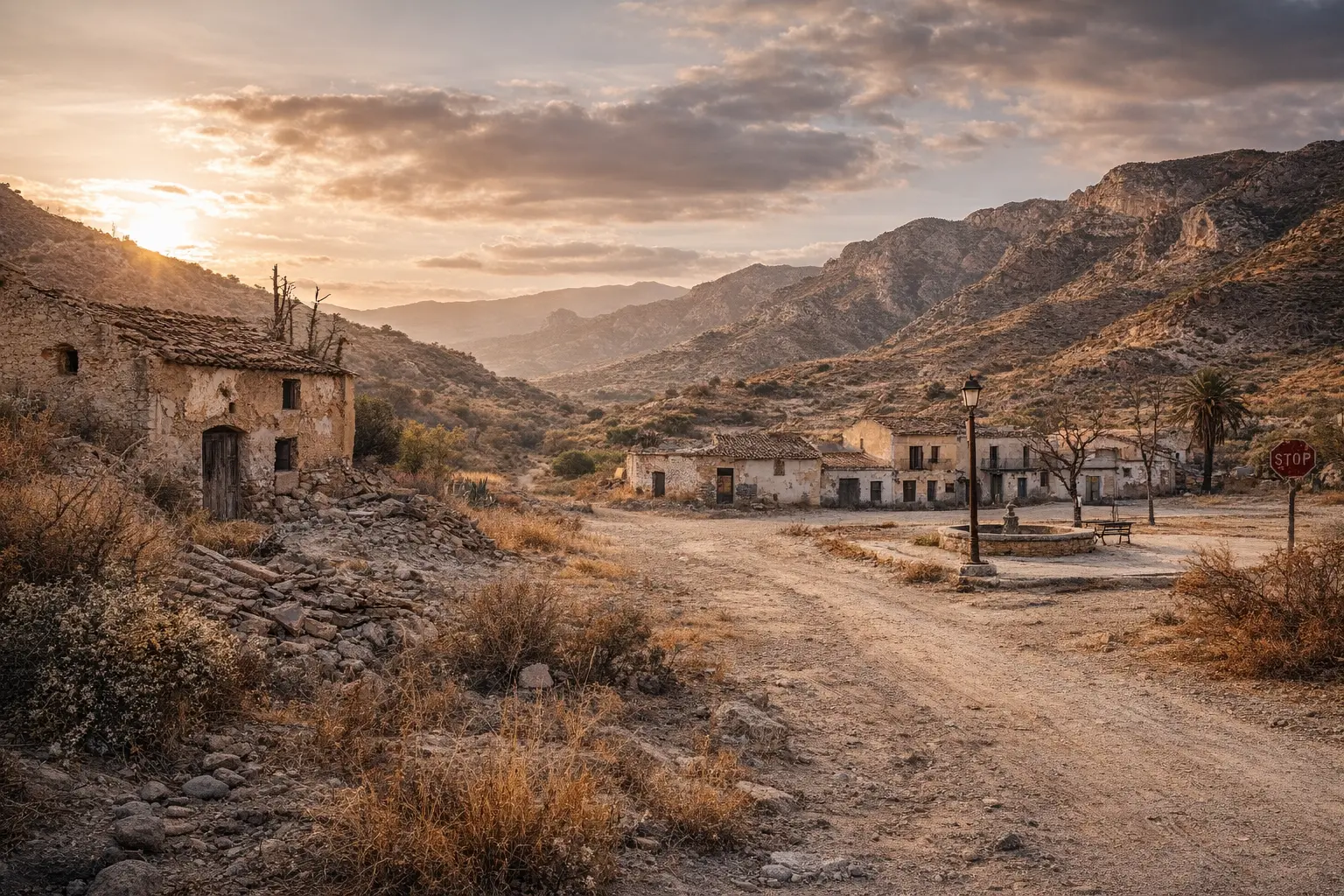
What inland Almeria offers above all else is quiet. Not curated tranquillity, but genuine absence of noise, choice and stimulation.
For some people, this is restorative. For others, it becomes oppressive after a few days.
Shops close early. Sundays are slow. Social life is visible but inward-facing. Integration, whether temporary or long-term, requires effort and humility.
There is little tolerance for spectacle. The interior does not perform for visitors.
This is where many mismatches occur: visitors arrive seeking peace, but underestimate how complete that peace can be.
Climate is not “mild” — it is extreme and predictable
Marketing often frames inland Almeria as a year-round destination thanks to sun and low rainfall. This is technically accurate, but practically misleading.
Summers are intense. Shade is limited. Heat management defines daily life. Winters, while often sunny, can be genuinely cold at altitude, with snow not uncommon in the Filabres or Alpujarra.
The climate is stable, not gentle. If you doubt that, check the official AEMET climate normals for Almeria — the evaporation rates and temperature swings leave little room for romanticism.
Inland Almeria and the coastal myth
The interior is frequently positioned as a counterpoint to the coast — quieter, more authentic, less developed. This comparison is both fair and lazy.
Many inland areas depend economically on coastal dynamics, whether through seasonal work, logistics or second-home patterns. Likewise, the coast often relies on the interior for agriculture, water and labour.
They are not opposites. They are interdependent.
Understanding inland Almeria requires stepping outside the coastal vs rural narrative entirely.
Who inland Almeria is for
Inland Almeria tends to work well for people who:
- value quiet over choice
- accept limited services without frustration
- enjoy repetition and routine
- plan ahead rather than improvising
- are comfortable being observers, not participants
It tends not to work for those who:
- expect convenience or spontaneity
- require constant variety
- interpret silence as absence
- want tourism to meet them halfway
Neither preference is better. They are simply different.
Frequently asked questions
Is inland Almeria suitable for a short holiday?
It can be, but it works best for visitors who enjoy slow pacing, planning ahead and limited choice. For short trips focused on variety or spontaneity, the coast is often a better fit.
Is inland Almeria good for hiking and cycling?
Yes, but with preparation. Routes are long, services are limited and conditions can be extreme. It suits experienced walkers and cyclists more than casual activity seekers.
Is inland Almeria quiet all year round?
Largely yes. Summer and weekends bring some movement, but most inland areas remain calm year-round, especially outside peak seasons.
Who should avoid inland Almeria?
Visitors who need convenience, constant entertainment or frequent choice often find inland Almeria restrictive rather than relaxing.
Inland Almeria doesn’t adjust itself to visitors. If you come prepared, it can be deeply rewarding. If you don’t, it will simply remain what it is.
For a broader picture of daily life inland, our village guide shows how individual towns and villages function year-round, including their local holidays.
Looking for honest, grounded insights into places across the province? Explore more in our Towns & Villages and Travel Tips sections.
Travel Tips
Canjayar guide. Discover Canjayar
Published January 4, 2026 | Category: Travel Tips
TL;DR: Canjayar is a larger inland town in the Andarax valley with basic services and facilities. It functions as a local centre rather than a tourist village.
Canjayar is a working valley town built around services, agriculture and routine
Canjayar lies in the Andarax valley in inland Almeria, positioned between smaller agricultural villages and the higher Alpujarra settlements. It is not a destination shaped by tourism or scenery, but by function. This is a town that exists to serve its surroundings: administratively, commercially and socially.
Compared to nearby villages, Canjayar feels larger, more structured and more active. Streets are wider, traffic is more present and daily life follows working schedules rather than visitor patterns. For travellers expecting a quiet white village, this can feel abrupt. For residents and long-term visitors, it provides stability and access to services that are otherwise scarce in the valley.
Contents
- Overview and location
- History and identity
- What the town feels like
- Services and facilities
- Agriculture and local economy
- Traditional food and eating habits
- Market and local commerce
- Festivals and local events
- Access and movement
- Campers, motorhomes and caravans
- Why stop here / why skip it
- Practical information
- Who is Canjayar for?
Overview and location
Canjayar is located along the A-348, the main road running through the Andarax valley. This position makes it a natural junction point between inland farming communities and the provincial capital of Almeria. The surrounding landscape is defined by olive groves, vineyards and terraced slopes rather than dramatic mountain scenery.
The town sits at approximately 618 metres above sea level. Summers are hot and dry, while winters are cooler than on the coast, especially at night. Seasonal rhythms strongly influence daily routines, with early starts during summer months and quieter afternoons during peak heat.
History and identity
Canjayar’s identity is anchored in a single event that still defines the town’s self-image today. In 1611, a wooden cross was reportedly discovered inside a wall following a recurring dream experienced by a local caretaker. This episode, later formalised as the cult of the Santo Cristo del Bosque, became the spiritual and symbolic centre of the town.
The scale of the main church is the clearest physical expression of that moment. It is strikingly large for a town of Canjayar’s current size, built for a population and a level of regional importance that no longer exists. This is not decorative excess; it is a monument to a period when Canjayar saw itself as a central reference point in the valley.
That contrast still matters. The church is not oversized by accident, nor by poor planning. It reflects a historical confidence — some would call it ambition — that has outlived the demographic reality of the town. In practical terms, Canjayar today operates as a service centre. Symbolically, it continues to present itself as something larger.
Religious celebrations linked to the Holy Cross are therefore not just tradition, but continuity. They reinforce an identity rooted in a past moment of importance, one that still shapes how the town understands its role within the Andarax valley.
What the town feels like
Canjayar feels practical and lived-in. The main streets are designed for movement and commerce rather than visual appeal. Traffic, including agricultural vehicles, is part of everyday life.
This is not a town that performs charm. It operates. Shops open to serve locals, cafés cater to routine customers, and public spaces are used functionally. Visitors expecting curated authenticity may feel disconnected; those seeking a realistic inland town will recognise the rhythm immediately.
Services and facilities
Canjayar functions as a service centre for the surrounding valley, and that role is practical rather than aspirational. The town has two banks — Unicaja and Cajamar — which, for this part of inland Almeria, is effectively the full menu. Both provide cash machines, but opening hours are limited and should not be assumed outside standard weekday mornings.
This matters. If you arrive late, during siesta, or on a local holiday, you may find doors closed and queues forming around the few working ATMs. Foreign cards generally work, but this is not a place for last-minute banking confidence. Treat Canjayar as a place to plan ahead, not to improvise.
Supermarkets exist to serve local households and agricultural workers. These are not delicatessen-style food shops or places for curated browsing. Expect bulk products, large-format staples and practical pricing. Five-kilo bags of flour make more sense here than artisan olive oil gift sets.
There is also a pharmacy, basic retail and everyday services that are absent in smaller neighbouring villages. This is why residents from surrounding settlements regularly travel into Canjayar: not for choice, but for access.
The key point is simple. Canjayar does not offer variety; it offers reliability. If you need essentials, you will find them here. If you are looking for selection, atmosphere or extended opening hours, you are in the wrong town.
Agriculture and local economy
Agriculture is central to Canjayar’s economy. Olive oil and grape cultivation dominate the valley, and the presence of large storage buildings and agricultural infrastructure reflects this focus.
During harvest periods, the town becomes noticeably busier. The smell of pressed olives, the movement of machinery and increased traffic are all part of seasonal life. This reinforces the town’s identity as a working centre rather than a residential retreat.
Traditional food and eating habits
Food in Canjayar follows traditional inland Andalusian patterns. Menus are shaped by familiarity and routine rather than experimentation. Expect stews, grilled meats, seasonal vegetables and simple desserts.
Opening hours can be limited outside peak periods, and dining is structured around local schedules. Lunch remains the main meal of the day, and evenings are generally quieter than in coastal towns.
Market and local commerce
Canjayar hosts a small general market on the 1st and 15th of each month, usually between 9:00 and 14:00 along Calle Santa Cruz. On paper, that sounds structured. In practice, it is subject to the usual Andalusian uncertainty. When market days fall on a Sunday or a public holiday, outcomes vary: sometimes the market shifts, sometimes it shrinks, sometimes it simply does not happen. Locals know. Visitors often do not.
The scale is modest. Around ten stalls is typical, which makes the market functional rather than expressive. This is not a place for regional pride or artisan discovery. It exists to serve routine needs.
The offer is predictable: clothing basics, socks, household plastics, inexpensive accessories and everyday items. If you have seen one small inland market in Almeria, you have effectively seen this one. There are no hidden gems here and no reason to build a visit around it.
In context, the market reflects the town itself. Despite Canjayar’s role as a local centre, the market remains skeletal. It is practical, unambitious and easy to miss. Come if you happen to be nearby on the right morning; do not come expecting atmosphere or variety.
Festivals and local events
The town’s festive calendar is closely tied to religious celebrations. Events related to the Holy Cross are among the most significant, alongside seasonal fiestas organised by the municipality.
During these periods, Canjayar becomes noticeably more active. Streets are busier, social life extends into the evening and the town briefly takes on a different rhythm. Outside fiesta dates, life returns quickly to its usual pace.
For province-wide public holidays, see Almeria local holidays.
Access and movement
Canjayar is easy to reach by road and sits directly on the A-348, which makes it a natural stop in the Andarax valley. Movement inside the town, however, follows local rules more than official ones. Agricultural vehicles and working vans set the pace, and the centre can feel chaotic at ordinary moments, not only during fiestas.
Parking in the central streets is not “a bit tight”. It is a patience test. Locals will stop a van where it suits them, put the hazard lights on, and treat the road as temporarily theirs while they buy bread or run an errand. This is normal behaviour here. If you approach the centre with visitor expectations, you will end up frustrated.
Practical advice: avoid driving into the plaza area if you do not have to. Park on the edge of town or on wider streets, then walk in. The locals own the asphalt here; you are just passing through.
The same applies to traffic. Tractors and slow vehicles are part of daily life, and the correct response is not aggression but adaptation. Build extra minutes into your route and treat Canjayar as a working town, not a visitor zone.
Campers, motorhomes and caravans
Canjayar is used by some camper and motorhome travellers as a practical stop rather than a destination. Facilities are limited and intended for short stays.
This is not a campsite. Camping behaviour such as setting up tables, awnings or extended stays is generally discouraged. Travellers should treat Canjayar as a service stop: park, rest, resupply and move on.
Important: wild camping is not permitted. Always follow local regulations and signage.
Why stop here / why skip it
Why stop here:
- Access to banks, supermarkets and a pharmacy
- Reliable place to resupply before entering smaller villages
- Clear example of a functioning inland Andalusian town
Why skip it:
- Limited visual appeal compared to white villages
- No concentrated tourist attractions
- Daily life prioritises locals over visitors
Practical information
- Car recommended: yes
- Best use: service stop or base for the valley
- Shops: open mainly mornings and early afternoons
- Official website: Ayuntamiento de Canjayar
The municipal website
The official town hall website is available and useful in theory, but the experience is slow and dated. Pages can take long enough to load that it becomes easier to ask a local in the plaza than to wait for the information to appear on screen. Ayuntamiento de Canjayar
This matters because it reflects the wider reality. If you ever need to do more than buy bread and withdraw cash — paperwork, municipal procedures, appointment-style errands — you should expect the same pace and friction. Canjayar works, but it works on local time.
Practical advice: if you rely on online municipal information, check it early and double-check it. For anything time-sensitive, confirm locally rather than trusting a last-minute web lookup.
Who is Canjayar for?
Canjayar suits travellers and residents who value practicality over aesthetics. It works well for people staying inland for longer periods, remote workers who need services, and those exploring the Andarax valley systematically.
It is less suitable for visitors seeking scenic village experiences, nightlife or a concentrated tourist offering.
Want more structured guides to inland towns and villages? Browse the full collection in Towns & Villages.

Uleila del Campo guide. Discover Uleila del Campo

Lucainena de las Torres guide. Discover Lucainena de las Torres

Almond blossom routes in Almeria: villages, walks and when to go

Events in Almeria: January & February concerts, theatre and Carnaval

Albox sets out key projects for 2026 as new municipal budget takes effect

€5.4 million investment approved for new wastewater collectors in Balanegra, Berja and Dalias

Hailstorm hits Adra on Three Kings’ Day as Storm Francis brings more unstable weather

Almeria remains “frozen” as Storm Francis lingers, with frost alerts and road impacts

Antas plans cultural and walking landmark at Cabezo Maria

Rain shortens Three Kings Parade in Huércal-Overa


Almeria Housing Market Outlook 2026: Rising Prices, Slower Pace
Published December 30, 2025 | Category: Real Estate & Economy TL;DR: Almeria enters 2026 with a housing market that is...


€26 million allocated for new AVE railway station in Almeria
Published December 23, 2025 | Category: Infrastructure TL;DR: The Andalusian regional government will invest €26 million in the future AVE...


Costa de Almeria closes 2025 with strong tourism momentum ahead of FITUR 2026
Published December 23, 2025 | Category: Community TL;DR: Costa de Almeria has wrapped up 2025 with more than 70 tourism...

High-Speed Rail to Almeria Faces New Challenge After Roman Cemetery Found in Lorca
Published December 22, 2025 | Category: Infrastructure TL;DR: A late Roman cemetery discovered during AVE tunnelling works in Lorca adds...
Uleila del Campo guide. Discover Uleila del Campo
Published January 8, 2026 | Category: Towns & Villages TL;DR: Uleila del Campo is a working inland village, not a...
Lucainena de las Torres guide. Discover Lucainena de las Torres
Published January 8, 2026 | Category: Towns & Villages TL;DR: Lucainena de las Torres is a small, well-kept village in...

Cantoria guide. Discover Cantoria
Published January 6, 2026 | Category: Towns & Villages TL;DR: Cantoria is a larger inland town in the Almanzora valley...

Canjayar guide. Discover Canjayar
Published January 4, 2026 | Category: Travel Tips TL;DR: Canjayar is a larger inland town in the Andarax valley with...
-
 Community4 days ago
Storm Francis brings snow to inland Almeria as yellow alert remains active
-
 Community5 days ago
AEMET activates yellow alert in Almeria as Storm Francis brings heavy rain
-

 Events6 days ago
Three Kings parades moved forward in Almeria
-
 Travel Tips6 days ago
Benahadux guide. Discover Benahadux
-

 Community6 days ago
Storm Francis brings heavy rain